
Built so you can check the work
Six things Wavefront does that a writing tool doesn't. In the order that matters.
Every change is a diff you can revert
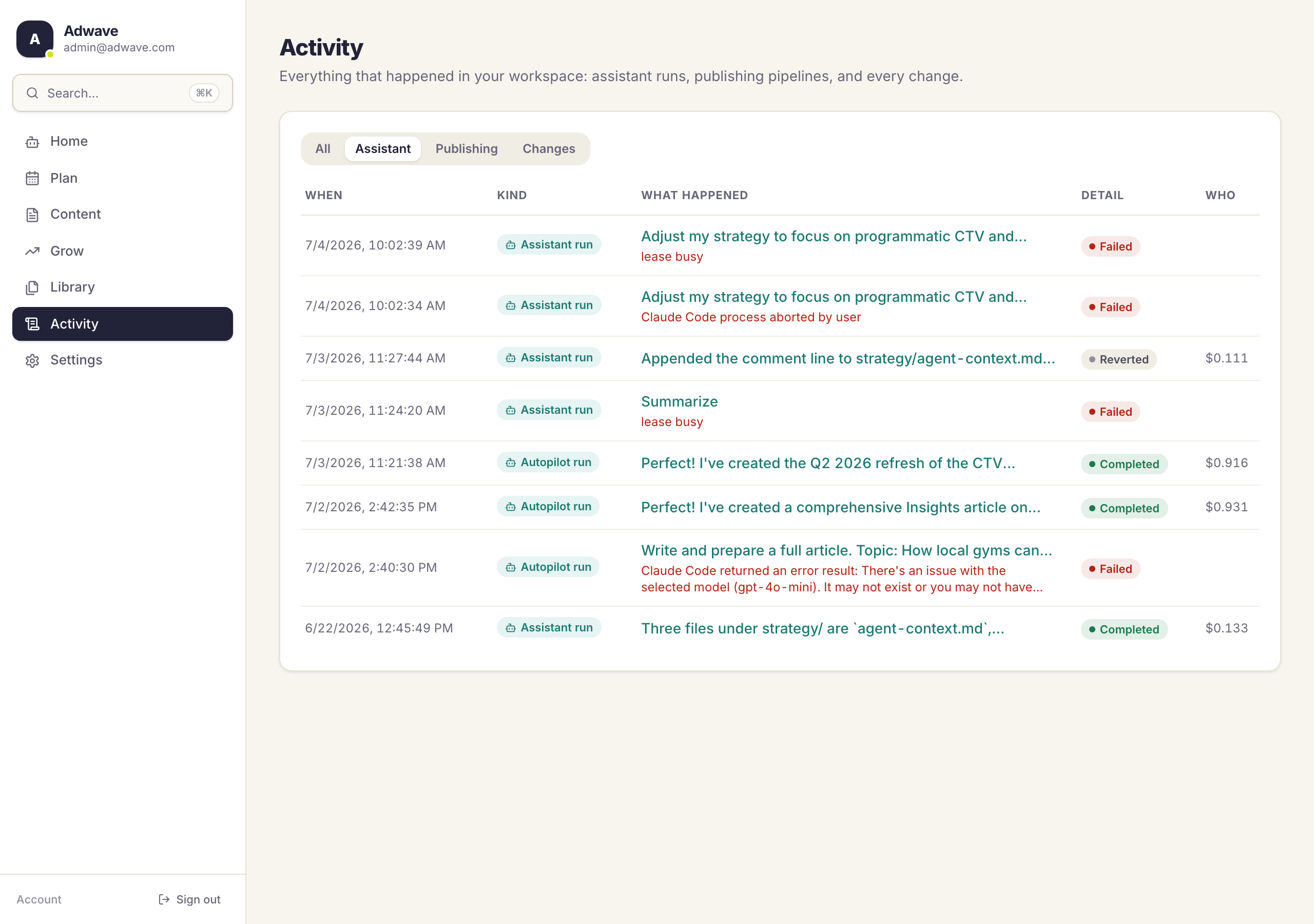
The agent doesn't act on a hidden copy of your content. It works on your real workspace files, and every run produces a changeset. Open the run, read the diff, revert one file or the whole thing. The audit log records everything else: who changed what, when, human or agent.
- An Activity timeline with the full changeset per run
- Per-file revert and whole-run revert
- Token and cost tracking on every run
- Versioned audit log across the workspace
- Role checks on every tool: viewer, writer, admin, billing
A QC gate between the agent and your site
Drafts are written against your brand rules and validated before anything publishes: title hygiene, sourced statistics, internal links checked against your live sitemap, keyword collisions, structure requirements from your content-type contracts. Failures don't ship; they wait for a person.
- Guidelines engine: your rules, applied to every draft
- Pass, warn, fail verdicts with the specific findings
- Cannibalization checks against your keyword registry
- Publish stays blocked until failures are resolved or waived
- Title within 60 characters, primary keyword front-loaded
- All 14 statistics carry a linked source
- No keyword collision with existing pages (cannibalization check)
- Internal links resolve against the live sitemap
- Meta description is 168 characters (limit 155)
- FAQ section has 3 questions (guideline: 4 to 6)
Weekly proposals from your real analytics
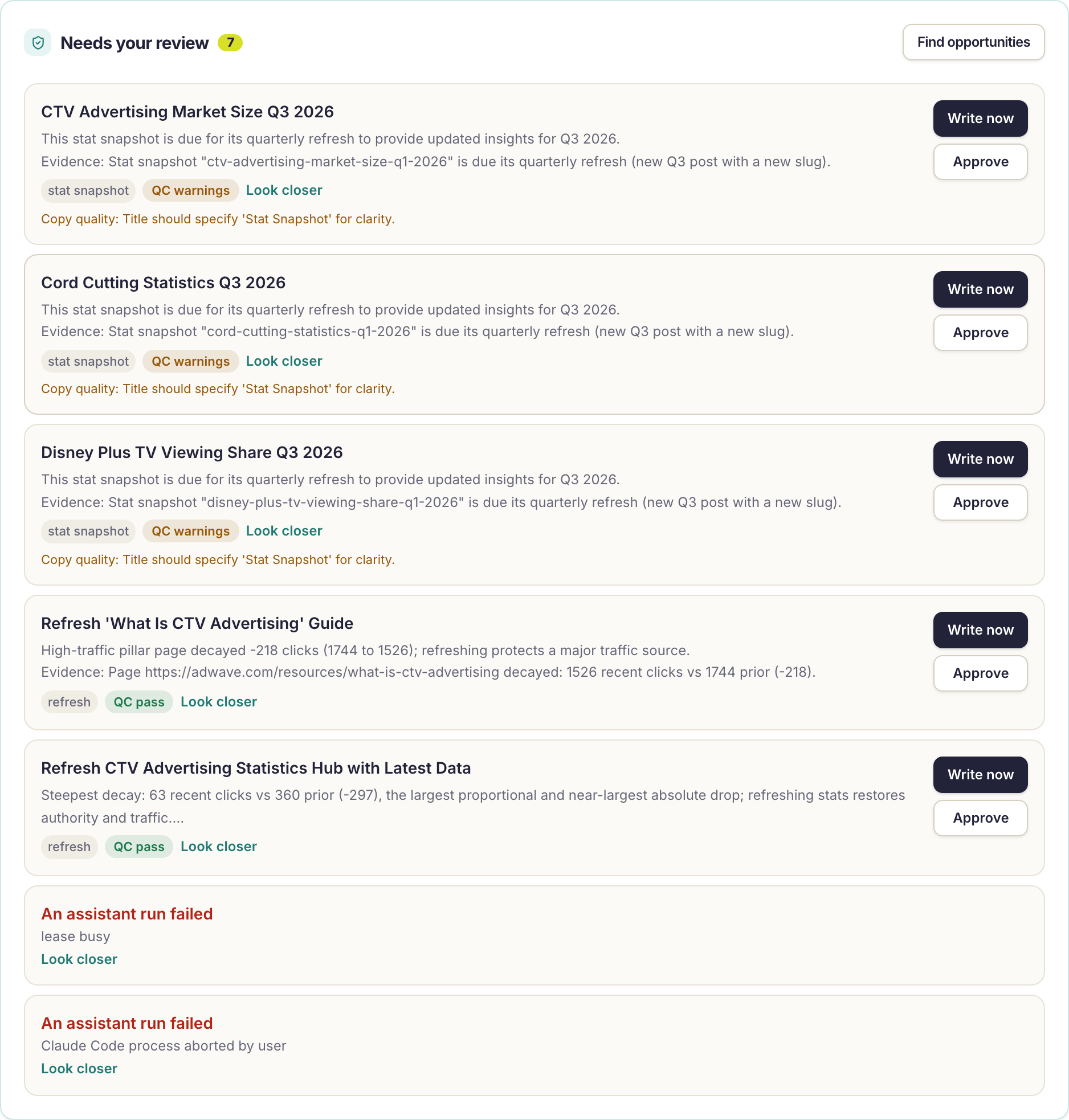
The Growth Review reads Search Console and GA4 every week and finds the moves with the most upside: queries ranking 5 to 20 that one push takes to page one, pages whose clicks are decaying, traffic that converts at zero, statistics posts due a quarterly refresh. At most five proposals per run, each with the metric rows that justified it.
- Striking-distance queries, content decay, conversion gaps, stat refreshes
- Evidence attached to every proposal, so you see the why before you approve
- Duplicate and cannibalization filtering in code, not in a prompt
- One click from proposal to written draft
Know what AI says about your brand, and fix it
When buyers ask ChatGPT or Perplexity about your category, do you show up, described correctly, recommended without hedging? The Brand Visibility Audit scores five layers (Discoverability, Clarity, Authority, Trust, Agentic readiness), shows the verbatim answers and hedge language, builds the quarterly Citation Core of domains AI actually trusts in your category, and turns every gap into a finding with an owner and a fix route. Honestly: components without data say so, bets are labeled bets, and the proxy panel never fakes citations.
- 0-100 score with the full component math visible, per engine
- Wrong-vs-missing diagnosis against your canonical brand description
- Business-critical prompts alert when AI stops endorsing you
- Citation Core: which domains cite competitors but not you
- Content fixes flow straight into the review queue; the agent writes them
Strategy that stays visible
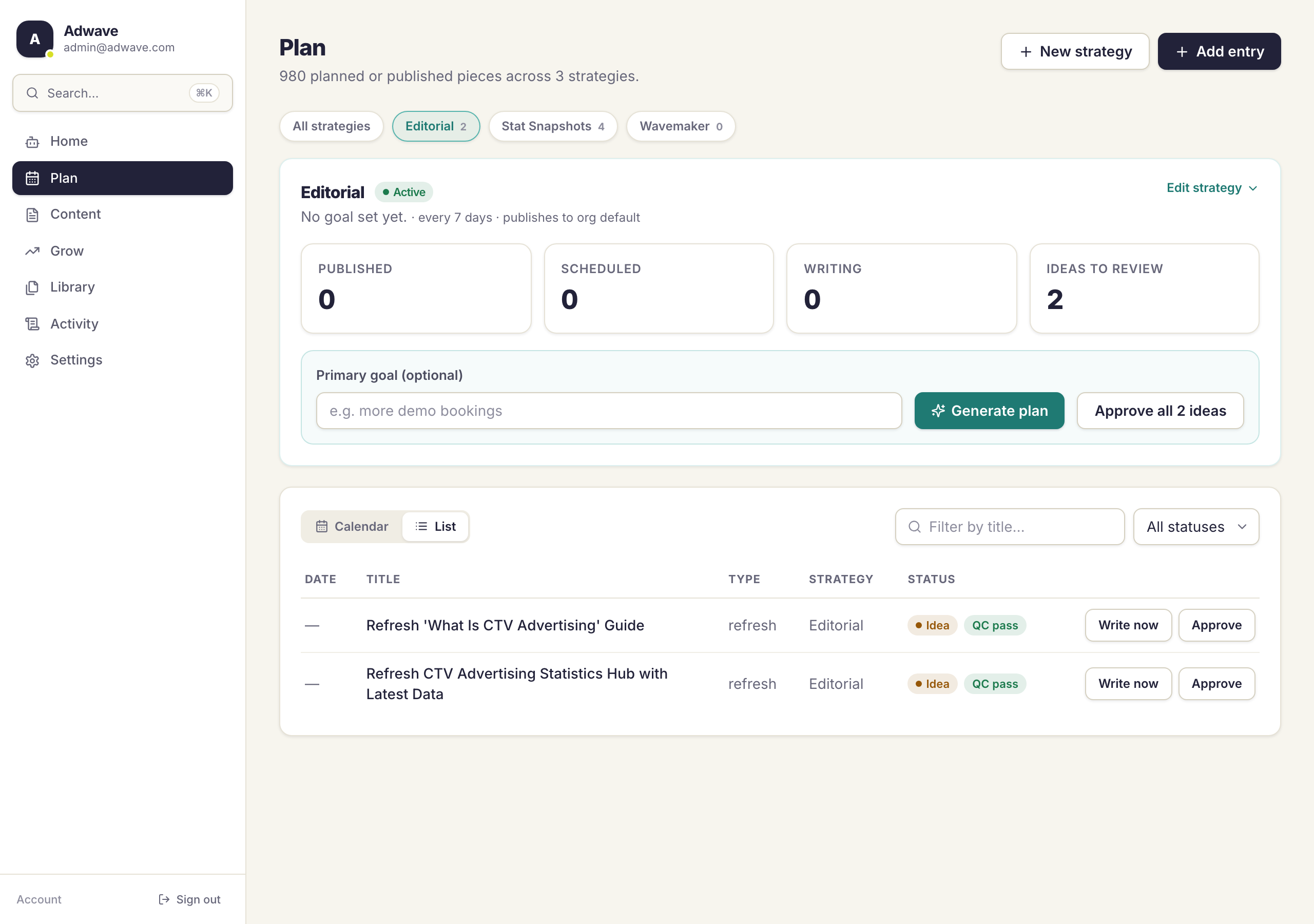
Goals, pillars, cadence, and every post's status live on the Plan page, not in a doc nobody opens. Run several strategies at once, each with its own cadence and CMS destination. The co-pilot proposes; you approve; the calendar fills itself.
- Multiple strategies with per-strategy CMS routing
- One calendar with statuses, scheduling, and QC badges
- Strategy stats right on the Plan page
An assistant that knows your business
The library is the assistant's long-term memory: your documents and playbooks, per-type editorial contracts (word targets, structure, QC checklists), writing guidelines, a keyword registry, and per-article briefs. Upload what you have; the welcome wizard builds the rest from your website.
- Documents, guidelines, keywords, and briefs in one place
- Content-type contracts that drafts are validated against
- Brand kit generated from your URL in onboarding
251 tools, yours over MCP
Everything the in-app assistant can do is exposed as a remote MCP server. Connect Cursor, Claude Code, or Claude Desktop and drive the same audited, role-checked tools from your own editor: plan, draft, illustrate, validate, publish. API keys for models, images, and scraping live on the platform, never in your client.
- 251 tools across 15 modules, role-gated per caller
- Same audit log and QC gate as the in-app assistant
- No provider keys to manage in your editor
- Available on Pro and Scale plans
See it on your own content
The free plan runs the whole loop: strategy, drafts, QC, and publishing. Paste your URL and judge the output yourself.
Start freeNo credit card. Upgrade only when it earns it.